This page was generated from /home/docs/checkouts/readthedocs.org/user_builds/blm/checkouts/latest/docs/tasks/task4.ipynb.
Interactive online version:
 Slideshow:

1.5. Understanding Surface Properties (4): Heat Storage and Surface Resistance
1.5.1. Objectives
Understand how to calculate ground heat flux.
Understand how to back-calculate surface resistance.
1.5.2. Calculation of heat storage: OHM (Objective Hysteresis Model) and a simple scheme
The objective hysteresis model helps us estimate the ground surface heat flux using the measured net radiation data. The equation for this model is as follows:
where \(\Delta Q_S\) is the ground heat flux (W m\(^{-2}\)), \(Q^*\) is the net radiation (W m\(^{-2}\)), and \(a_{1-3}\) are the coefficients to be determined from measurements
In this task, we focus on a simpler model instead of the above question using just the first term:
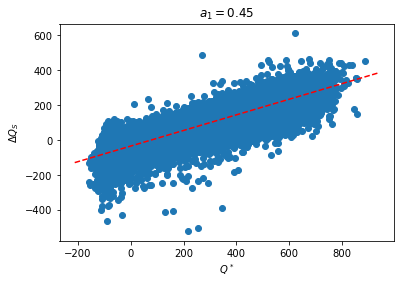
The aim is to find \(a_1\) using the measurements.
1.5.2.1. Tasks
1.5.2.1.1. Load necessary packages
[1]:
import numpy as np
import matplotlib.pyplot as plt
import pandas as pd
from pathlib import Path
1.5.2.1.2. Loading data
[2]:
group_number = 7
path_dir = Path.cwd() / 'data' / f'{group_number}'
# examine available files in your folder
list(path_dir.glob('*gz'))
[2]:
[PosixPath('/Users/hamidrezaomidvar/Desktop/BLM-task4/data/7/US-Whs_clean.csv.gz'),
 PosixPath('/Users/hamidrezaomidvar/Desktop/BLM-task4/data/7/US-NC1_clean.csv.gz')]
[3]:
# specify the site name
name_of_site = 'US-Whs'
[4]:
# load dataset
site_file = name_of_site + '_clean.csv.gz'
path_data = path_dir / site_file
df_data = pd.read_csv(path_data, index_col='time', parse_dates=['time'])
df_data.head()
[4]:
| WS | RH | TA | PA | WD | P | SWIN | LWIN | SWOUT | LWOUT | NETRAD | H | LE | USTAR | ZL | |
|---|---|---|---|---|---|---|---|---|---|---|---|---|---|---|---|
| time | |||||||||||||||
| 2007-06-29 13:30:00 | 4.063 | 12.6475 | 34.790 | 86.3667 | 273.75 | 0.0 | 1096.50 | NaN | NaN | NaN | 609.9 | 339.3645 | 12.2582 | 0.4036 | NaN |
| 2007-06-29 14:00:00 | 3.636 | 12.2413 | 35.140 | 86.3323 | 322.30 | 0.0 | 1057.00 | NaN | NaN | NaN | 562.8 | 290.9766 | 14.5989 | 0.5052 | NaN |
| 2007-06-29 14:30:00 | 3.107 | 12.0811 | 35.490 | 86.3048 | 316.75 | 0.0 | 1107.50 | NaN | NaN | NaN | 596.4 | 359.2087 | 16.1474 | 0.3566 | NaN |
| 2007-06-29 15:00:00 | 4.302 | 11.6801 | 36.190 | 86.2589 | 292.30 | 0.0 | 1108.00 | NaN | NaN | NaN | 613.5 | 360.5630 | 10.0565 | 0.5340 | NaN |
| 2007-06-29 15:30:00 | 3.676 | 13.7432 | 34.785 | 86.2429 | 209.20 | 0.0 | 496.15 | NaN | NaN | NaN | 232.0 | 200.0689 | 64.8520 | 0.4503 | NaN |
Assuming surface energy closure in measurements is perfect, i.e., \(Q^*=Q_H+Q_E+\Delta Q_S\)
Note: conduct the derivation at different sites separately so you can get two sets of coefficients for later comparison.
1.5.2.1.3. Calculating \(\Delta Q_S\)
[5]:
df=df_data.filter(['NETRAD','H','LE'])
df.dropna(inplace=True)
QSTAR=df.NETRAD
QH=df.H
QE=df.LE

QS=QSTAR-QH-QE


QS.plot(figsize=(15,4))
plt.ylabel('$\Delta Q_S$')
[5]:
Text(0, 0.5, '$\\Delta Q_S$')

1.5.2.1.4. Finding \(a_1\)
[6]:
from scipy.stats import linregress

fig, ax = plt.subplots(1, 1)
slope = linregress(QSTAR, QS).slope
intercept=linregress(QSTAR, QS).intercept

ax.scatter(QSTAR, QS)
lim = ax.get_xlim()
plt.plot(lim, [x * slope+intercept for x in lim], color='r', linestyle='--')
plt.title(f'$a_1 = {slope:.2f}$')
plt.ylabel('$\Delta Q_S$')
plt.xlabel('$Q^*$')
[6]:
Text(0.5, 0, '$Q^*$')
1.5.2.1.5. Compare derived OHM coefficients between sites
[7]:
# your code here
1.5.2.1.6. Calculate \(\Delta Q_S\) using provided OHM coefficients
Use the values provided in this page of SUEWS manual
[8]:
# your code here
1.5.2.1.7. examine the SEB closure using calculated
Think about proper metrics for quantitative examination.
[9]:
# your code here
1.5.3. calculate surface resistances \(r_s\)
\(r_s\) can be calculated as following
where
We are going to calculate each part separately and eventually integrate all parts together to get \(r_s\)
1.5.3.1. Calculate \(r_a\)
You should calculate \(r_a\) using task 3 and the function that you implemented before for the site: similarly for \(z_0\) and \(d\).
[21]:
# your code here
1.5.3.2. Calculating \(\beta=\frac{Q_{H}}{Q_{E}}\)
[10]:
df_val = df_data.loc[:, ['LE','H', 'USTAR', 'TA', 'RH', 'PA', 'WS']].dropna()
[11]:
# your code here
1.5.3.3. Calculating \(C_{a}=\rho c_{p}\)
For this, you can use the available functions in utility.py
Important:
In these functions, pressure is in hPa; so you need to convert the pressure from kPa to hPa
[12]:
df_val.PA *=10
[13]:
from utility import cal_dens_air, cal_cpa

#rho = cal_dens_air(Press_hPa, Temp_C)  #use this to calculate rho
#cp = cal_cpa(Temp_C, RH_pct, Press_hPa) #use this to calculate cp
1.5.3.4. Calculating \(s\)
[ ]:
# This package is needed
!pip install atmosp
[14]:
from utility import cal_des_dta
# s = cal_des_dta(Temp_C, Press_hpa) #use this to calculate s
1.5.3.5. Calculating \(V=e_{s}-e_{a}\)
[15]:
from utility import cal_vpd
# V = cal_vpd(Temp_C, RH_pct, Press_hPa)  #use this to calculate V
1.5.3.6. Calculating \(\gamma\)
[16]:
from utility import cal_gamma
#gamma = cal_gamma(Press_hPa) #use this to calculate gamma
1.5.3.7. Integrate: calculate \(r_s\)
[20]:
# your code here