This page was generated from /home/docs/checkouts/readthedocs.org/user_builds/blm/checkouts/latest/docs/tasks/task3.ipynb.
Interactive online version:
 Slideshow:

1.4. Understanding Surface Properties (3): Surface Roughness
1.4.1. Objectives
Understand how to quantify surface roughness
Understand variability of surface roughness
Tips:
Eddy Covariance observations allow several important parameters to be determined:
Zero plane displacement length \(d\) can be calculated based on vegetation height (think about changes in LAI and porosity). If there is a profile of anemometers (e.g. as at the Observatory) then this can be calculated using that.
Roughness length \(z_0\) can be calculated from the EC data (EddyCovariance) by rearranging the logarithmic law from the neutral wind profile WindProfile).
Do these vary with season? Wind Direction? Create a graph to analyse the data (think about wind directions).
How do these values compare to the literature?
Calculate the aerodynamic resistance \(r_a\).
For scientific background see Roughness and Reading List
1.4.2. Tasks
1.4.2.1. load necessary packages
[1]:
import numpy as np
import matplotlib.pyplot as plt
import pandas as pd
from pathlib import Path
1.4.2.2. loading data
[2]:
group_number = 10
path_dir = Path.cwd() / 'data' / f'{group_number}'
# examine available files in your folder
list(path_dir.glob('*gz'))
[2]:
[PosixPath('/Users/sunt05/Dropbox/6.Repos/BLM-task3/data/10/US-Oho_clean.csv.gz'),
 PosixPath('/Users/sunt05/Dropbox/6.Repos/BLM-task3/data/10/CA-TPD_clean.csv.gz')]
[3]:
# specify the site name
name_of_site = 'CA-TPD'
[4]:
# load measurement heights
df_zmeas = pd.read_csv('data/measurement_height.csv', index_col=0)
df_zmeas.loc[name_of_site].iloc[:]
[4]:
| Variable | Start_Date | Height | Instrument_Model | Instrument_Model2 | Comment | BASE_Version | |
|---|---|---|---|---|---|---|---|
| Site_ID | |||||||
| CA-TPD | CO2_1_1_1 | 2012.0 | 35.70 | GA_CP-LI-COR LI-7200 | NaN | LI-7200 IRGA) | 02-May |
| CA-TPD | CO2_1_2_1 | 2012.0 | 16.00 | GA_SR-LI-COR LI-820 | NaN | LI820_CO2_Cnpy_16m (ppm); CO2 | 02-May |
| CA-TPD | FC | 2012.0 | 35.70 | GA_CP-LI-COR LI-7200 | NaN | NaN | 02-May |
| CA-TPD | FH2O | 2012.0 | NaN | NaN | NaN | NaN | 02-May |
| CA-TPD | LE | 2012.0 | 35.70 | GA_CP-LI-COR LI-7200 | NaN | NaN | 02-May |
| CA-TPD | PPFD_IN_PI_F_1_1_1 | 2012.0 | 35.13 | RAD-PAR Quantum | NaN | NaN | 02-May |
| CA-TPD | P_CUM | 2012.0 | 2.00 | NaN | NaN | NaN | 02-May |
| CA-TPD | PA_PI_F | 2012.0 | 2.00 | NaN | NaN | NaN | 02-May |
| CA-TPD | G_1_1_1 | 2012.0 | 0.00 | SOIL_H-Plate | NaN | NaN | 02-May |
| CA-TPD | G_2_2_1 | 2012.0 | -0.03 | SOIL_H-Plate | NaN | NaN | 02-May |
| CA-TPD | G_3_2_1 | 2012.0 | -0.03 | SOIL_H-Plate | NaN | NaN | 02-May |
| CA-TPD | G_4_2_1 | 2012.0 | -0.03 | SOIL_H-Plate | NaN | NaN | 02-May |
| CA-TPD | G_1_2_1 | 2012.0 | -0.03 | SOIL_H-Plate | NaN | NaN | 02-May |
| CA-TPD | GPP_PI_F | 2012.0 | 35.70 | GA_CP-LI-COR LI-7200 | NaN | NaN | 02-May |
| CA-TPD | H | 2012.0 | 35.70 | GA_CP-LI-COR LI-7200 | NaN | NaN | 02-May |
| CA-TPD | H_PI_F | 2012.0 | 35.70 | GA_CP-LI-COR LI-7200 | NaN | NaN | 02-May |
| CA-TPD | LE_PI_F | 2012.0 | 35.70 | GA_CP-LI-COR LI-7200 | NaN | NaN | 02-May |
| CA-TPD | NEE_PI | 2012.0 | 35.70 | GA_CP-LI-COR LI-7200 | NaN | NaN | 02-May |
| CA-TPD | NEE_PI_F | 2012.0 | 35.70 | GA_CP-LI-COR LI-7200 | NaN | NaN | 02-May |
| CA-TPD | PPFD_IN_1_1_1 | 2012.0 | 35.13 | RAD-PAR Quantum | NaN | Kipp and Zonen | 02-May |
| CA-TPD | PPFD_IN_1_2_1 | 2012.0 | 2.00 | RAD-PAR Quantum | NaN | NaN | 02-May |
| CA-TPD | PPFD_OUT | 2012.0 | 35.13 | RAD-PAR Quantum | NaN | Kipp and Zonen | 02-May |
| CA-TPD | P | 2012.0 | 2.00 | PREC-TipBucGauge | NaN | CSI (heated and Alter Shielded) in a forest op... | 02-May |
| CA-TPD | PA | 2012.0 | 2.00 | PRES-ElectBar | NaN | Young Co | 02-May |
| CA-TPD | RECO_PI_F | 2012.0 | 35.70 | GA_CP-LI-COR LI-7200 | NaN | NaN | 02-May |
| CA-TPD | SW_IN | 2012.0 | 35.50 | RAD-Pyrrad-SW+LW | NaN | Kipp & Zonen CNR4 | 02-May |
| CA-TPD | SW_IN_PI_F | 2012.0 | 35.50 | RAD-Pyrrad-SW+LW | NaN | CNR1_GlobalShortwaveRad_AbvCnpy_36m (W/m2); Ga... | 02-May |
| CA-TPD | LW_IN | 2012.0 | 35.50 | RAD-Pyrrad-SW+LW | NaN | Kipp & Zonen CNR4 Net Radiometer | 02-May |
| CA-TPD | LW_OUT | 2012.0 | 35.50 | RAD-Pyrrad-SW+LW | NaN | Kipp & Zonen CNR4 Net Radiometer | 02-May |
| CA-TPD | SW_OUT | 2012.0 | 35.50 | RAD-Pyrrad-SW+LW | NaN | Kipp & Zonen CNR4 Net Radiometer | 02-May |
| ... | ... | ... | ... | ... | ... | ... | ... |
| CA-TPD | SWC_2_1_1 | 2012.0 | -0.02 | SWC-TDR | NaN | NaN | 02-May |
| CA-TPD | SWC_2_3_1 | 2012.0 | -0.10 | SWC-TDR | NaN | NaN | 02-May |
| CA-TPD | SWC_2_6_1 | 2012.0 | -1.00 | SWC-TDR | NaN | NaN | 02-May |
| CA-TPD | SWC_2_4_1 | 2012.0 | -0.20 | SWC-TDR | NaN | NaN | 02-May |
| CA-TPD | SWC_2_2_1 | 2012.0 | -0.05 | SWC-TDR | NaN | NaN | 02-May |
| CA-TPD | SWC_2_5_1 | 2012.0 | -0.50 | SWC-TDR | NaN | NaN | 02-May |
| CA-TPD | SWC_1_3_1 | 2012.0 | -0.10 | SWC-TDR | NaN | NaN | 02-May |
| CA-TPD | SWC_1_6_1 | 2012.0 | -1.00 | SWC-TDR | NaN | NaN | 02-May |
| CA-TPD | SWC_1_4_1 | 2012.0 | -0.20 | SWC-TDR | NaN | NaN | 02-May |
| CA-TPD | SWC_1_2_1 | 2012.0 | -0.05 | SWC-TDR | NaN | NaN | 02-May |
| CA-TPD | SWC_1_5_1 | 2012.0 | -0.50 | SWC-TDR | NaN | NaN | 02-May |
| CA-TPD | TS_2_3_1 | 2012.0 | -0.10 | TEMP-ElectResis | NaN | NaN | 02-May |
| CA-TPD | TS_2_6_1 | 2012.0 | -1.00 | TEMP-ElectResis | NaN | NaN | 02-May |
| CA-TPD | TS_2_4_1 | 2012.0 | -0.20 | TEMP-ElectResis | NaN | NaN | 02-May |
| CA-TPD | TA | 2012.0 | 36.60 | TEMP-ElectResis | NaN | Campbell Scientific Inc (CSI) | 02-May |
| CA-TPD | TS_2_2_1 | 2012.0 | -0.05 | TEMP-ElectResis | NaN | NaN | 02-May |
| CA-TPD | TS_2_5_1 | 2012.0 | -0.50 | TEMP-ElectResis | NaN | NaN | 02-May |
| CA-TPD | TS_1_3_1 | 2012.0 | -0.10 | TEMP-ElectResis | NaN | NaN | 02-May |
| CA-TPD | TS_1_6_1 | 2012.0 | -1.00 | TEMP-ElectResis | NaN | NaN | 02-May |
| CA-TPD | TS_1_4_1 | 2012.0 | -0.20 | TEMP-ElectResis | NaN | NaN | 02-May |
| CA-TPD | TS_1_2_1 | 2012.0 | -0.05 | TEMP-ElectResis | NaN | Campbell Scientific Inc (CSI) | 02-May |
| CA-TPD | TS_1_5_1 | 2012.0 | -0.50 | TEMP-ElectResis | NaN | NaN | 02-May |
| CA-TPD | TS_PI_F_1_1_1 | 2012.0 | -0.02 | TEMP-ElectResis | NaN | NaN | 02-May |
| CA-TPD | TS_PI_F_1_2_1 | 2012.0 | -0.05 | TEMP-ElectResis | NaN | NaN | 02-May |
| CA-TPD | USTAR | 2012.0 | 35.70 | SA-Campbell CSAT-3 | NaN | NaN | 02-May |
| CA-TPD | VPD_PI | 2012.0 | 35.30 | RH-Capac | NaN | NaN | 02-May |
| CA-TPD | VPD_PI_F | 2012.0 | 35.30 | RH-Capac | NaN | NaN | 02-May |
| CA-TPD | WD | 2012.0 | 36.60 | WIND-VaneAn | NaN | NaN | 02-May |
| CA-TPD | WS | 2012.0 | 36.60 | WIND-VaneAn | NaN | NaN | 02-May |
| CA-TPD | WS_PI_F | 2012.0 | 36.60 | WIND-VaneAn | NaN | NaN | 02-May |
73 rows × 7 columns
from the table above, we know the measurement height for wind speed WS is 36.6 m.
We will use the value in the following calculation.
[5]:
# write down measurement height of wind speed
z_meas = 36.6
[6]:
# load dataset
site_file = name_of_site + '_clean.csv.gz'
path_data = path_dir / site_file
df_data = pd.read_csv(path_data, index_col='time', parse_dates=['time'])
df_data.head()
[6]:
| WS | RH | TA | PA | WD | P | SWIN | LWIN | SWOUT | LWOUT | NETRAD | H | LE | USTAR | ZL | |
|---|---|---|---|---|---|---|---|---|---|---|---|---|---|---|---|
| time | |||||||||||||||
| 2012-01-01 11:00:00 | NaN | NaN | NaN | NaN | NaN | NaN | NaN | NaN | NaN | NaN | NaN | -86.133 | 12.683 | 1.170 | NaN |
| 2012-01-01 11:30:00 | NaN | NaN | NaN | NaN | NaN | NaN | NaN | NaN | NaN | NaN | NaN | -71.325 | 28.933 | 1.188 | NaN |
| 2012-01-01 12:00:00 | NaN | NaN | NaN | NaN | NaN | NaN | NaN | NaN | NaN | NaN | NaN | -64.607 | 29.349 | 1.188 | NaN |
| 2012-01-01 12:30:00 | NaN | NaN | NaN | NaN | NaN | NaN | NaN | NaN | NaN | NaN | NaN | -94.362 | 36.909 | 1.295 | NaN |
| 2012-01-01 13:00:00 | NaN | NaN | NaN | NaN | NaN | NaN | NaN | NaN | NaN | NaN | NaN | -74.555 | 51.049 | 1.212 | NaN |
1.4.2.3. stability correction
You need to calculate Obukhov Stavility parameter as following:
where \(u_*\) is friction velocity; \(g\) is gravity; \(T\) is air temperature; \(k\) is von Kármán’s ‘constant’ (0.4); \(Q_H\) is turbulent sensible heat flux; \(\rho\) is air density; \(z\) is measurement height; and \(d\) is zero desplacement height
We use different functions for this. The functions are already implemented. You can use these functions in the future for different part of the model. Here some example how to use them.
[7]:
from utility import cal_vap_sat, cal_dens_dry, cal_dens_vap, cal_cpa, cal_dens_air, cal_Lob
[8]:
# saturation vapour pressure [hPa]
cal_vap_sat(0.0003, 1013)
[8]:
6.118926455724389
[9]:
# density of dry air [kg m-3]
cal_dens_dry(98, 23, 1013)
[9]:
1.1591455092830807
[10]:
# density of vapour [kg m-3]
cal_dens_vap(98, 23, 1013)
[10]:
0.020167600169459326
[11]:
# specific heat capacity of air mass [J kg-1 K-1]
cal_cpa(23, 30, 1013)
[11]:
1010.1394406405146
[12]:
# air density [kg m-3]
cal_dens_air(1013, 32)
[12]:
1.1564283022625206
[13]:
# Obukhov length
cal_Lob(500, 0.0001, 23, 90, 1020)
[13]:
-0.00018481221694860222
Now we can calculate Obukhov length (\(L\)). Let’s integrate all together:
Here you need to specify the height of the vegetation h_sfc . You can find this from the paper related to your site. Note that the height should be smaller than the measurement height
[14]:
# select valid values
df_val = df_data.loc[:, ['H', 'USTAR', 'TA', 'RH', 'PA', 'WS']].dropna()

# calculate Obukhov length
ser_Lob = df_val.apply(
    lambda ser: cal_Lob(ser.H, ser.USTAR, ser.TA, ser.RH, ser.PA * 10), axis=1)

# zero-plane displacement: estimated using rule f thumb `d=0.7*h_sfc`
h_sfc = 10
z_d = 0.7 * h_sfc

if z_d >= z_meas:
    print(
        'vegetation height is greater than measuring height. Please fix this before continuing'
    )

# calculate stability scale
ser_zL = (z_meas - z_d) / ser_Lob
[15]:
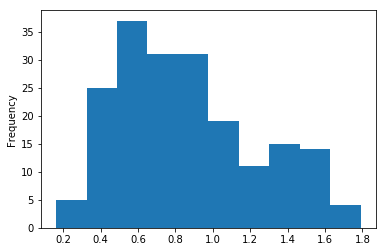
# determine periods under quasi-neutral conditions
limit_neutral = 0.01
ind_neutral = ser_zL.between(-limit_neutral, limit_neutral)
df_val.loc[ind_neutral, 'USTAR'].plot.hist()
[15]:
<matplotlib.axes._subplots.AxesSubplot at 0x1158fd940>
1.4.2.4. calculate roughness length \(z_0\) and zero plane displacement \(d\)
1.4.2.4.1. theoretical basis
We will employ the followng equation in our calculations:
where \(\bar{u}(z)\) is the measured wind speed at a height \(z\), \(u_{*}\) the friction velocity, \(d\) the zero-plane displacement, \(k\) the von Karman’s constant (a value of 0.4 used in the following calculation).
1.4.2.4.2. calculation
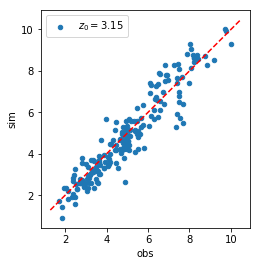
We will use scipy.optimize.curve_fit to determine the parameters \(z_0\) and \(d\) in the model above.
[16]:
from scipy.optimize import curve_fit
To use curve_fit, we need to define a function repensenting the model above:
[17]:
def func_uz(ustar, z0):
    z = z_meas
    d = 0.7 * h_sfc
    k = 0.4
    uz = ustar / k * np.log((z - d) / z0)
    return uz
[18]:
# choose the necessary variables
df_sel = df_val.loc[ind_neutral, ['WS', 'USTAR']].dropna()
[19]:
# set up input data for curve fitting
ser_ustar = df_sel.USTAR
ser_ws = df_sel.WS
# use `curve_fit` to get parameters of interest
z0_fit, _ = curve_fit(func_uz, ser_ustar, ser_ws, bounds=[(0), (np.inf)])
[20]:
# examine the results
res_fit = func_uz(ser_ustar, z0_fit).rename('sim')
res_obs = ser_ws.copy().rename('obs')
df_comp = pd.concat([res_obs, res_fit], axis=1)
ax = df_comp.plot.scatter(x='obs', y='sim', label=f'$z_0=${z0_fit[0]:.2f}')
lim = ax.get_xlim()
ax.plot(lim, lim, color='r', linestyle='--')
ax.set_aspect('equal')
[20]:
[<matplotlib.lines.Line2D at 0x127a4a048>]
1.4.2.4.3. Calculate aerodynamic resistance \(r_a\)
1.4.2.4.3.1. write down the equation used for this calculation
equation with explanations of symbol:
1.4.2.4.3.2. calculation
[21]:
# calculation code
1.4.2.4.4. examination of variability
[22]:
# calculation code