 Slideshow:

Data Analysis Tutorial for BLM
Dr Ting Sun (ting.sun@reading.ac.uk)
2018 Autumn
Basic Workflow
- Import (and pre-process)
- Analyse
- Deliver
Tools
Essential:
- numpy: a fundamental package for scientific computing
- pandas: a 1D (
Series) and 2D (DataFrame, aka tabular data) data analysis package - matplotlib: a plotting package for producing publication quality figures
Example 1: Evaporation analysis using Penman equation
Aim
- To obtain the essential skills in data analysis
- To understand the nature of the Penman equation
Questions
- How to use the Penman equation to estimate evaporation?
- what are the parameters that need to be prescribed?
- what are the input/forcing data you should prepare?
- Examination of Penman-based results
- how do we know the accuracy of our estimates? any ‘truth’ data?
- what indicators should we calculate?
- Importing the raw data and preprocessing it to do your own analysis?
- is it time-aware?
- any gaps? to fill or not? if needed, how to fill the gaps?
- What are extrinsic and intrinsic determinants of estimated evaporation based on Penman equation?
- what parameters are set by us?
- what forcing data are used?
- what will happen if we perturb/adjust some of/all the above factors? and why? any physical explanations?
Import
load necessary packages
[1]:
import pandas as pd
import numpy as np
import matplotlib.pyplot as plt
import seaborn as sns
%matplotlib inline
import raw data
[2]:
data_raw = pd.read_csv('../data/PM_rawdata.csv', header=[0, 1]).dropna(how='all')
data_raw.head().T.head()
[2]:
| 0 | 1 | 2 | 3 | 4 | ||
|---|---|---|---|---|---|---|
| TimeStamp | UTC | 2.01509e+07 | 2.01509e+07 | 2.01509e+07 | 2.01509e+07 | 2.01509e+07 |
| Time | hhmm | 5 | 10 | 15 | 20 | 25 |
| Td | deg C | 5.89 | 5.71 | 5.67 | 5.58 | 5.51 |
| Tw | deg C | 5.66 | 5.61 | 5.51 | 5.38 | 5.4 |
| RH | % | 98.3 | 98.9 | 98.7 | 98.1 | 98.7 |
Analyse
Modified Penman-Monteith equation:
Parameters:
factors that are NOT changing during one model run:
| symbol | unit | meaning | default value |
|---|---|---|---|
| \(\gamma\) | \(\mathrm{Pa\ {°C}^{-1}}\) | psychometric constant | 0.67 |
| \(\rho\) | \(\mathrm{kg\ {m}^{-3} }\) | density of air | 1.2 |
| \(c_p\) | \(\mathrm{J\ {m}^{-3} \ {°C}^{-1}}\) | heat capacity of air | 1004 |
| \(r_s\) | \(\mathrm{s\ m^{-1}}\) | surface resistance | 60 |
Forcing data
factors that should be provided at each time step during one model run:
| symbol | unit | meaning |
|---|---|---|
| \(Q^{*}\) | \(\mathrm{W\ m^{-2}}\) | net wall-wave radiation |
| \(Q_{G}\) | \(\mathrm{W\ m^{-2}}\) | ground heat flux |
| \(e\) | \(\mathrm{Pa}\) | vapour pressure |
| \(T_a\) | \(\mathrm{°C}\) | air temperature |
| \(U\) | \(\mathrm{m\ s^{-1}}\) | wind speed |
Intermediate states
factors that are calculated based on forcing data and parameters but are NOT the main outputs
| symbol | unit | meaning |
|---|---|---|
| \(e_T\) | \(\mathrm{Pa}\) | saturation evaporation pressure |
| \({s}\) | \(\mathrm{Pa \ {°C}^{-1}}\) | slope of \(e_s(T_a)\) |
| \(r_a\) | \(\mathrm{s\ m^{-1}}\) | aerodynamic resistance |
Implementation: calc_PM
- auxiliary functions: we use
atmosas the basic utility.esat(Ta): saturation vapour pressure at \(T_a\)s(Ta): saturation vapour pressure slope at \(T_a\)ra(U): aerodynamic resistance at \(U\)
[4]:
from atmos import calculate as atm_calc


# saturation vapour pressure in [hPa] at Ta
def esat_hPa(Ta_K):
    return atm_calc('es', T=Ta_K)/100


# saturation vapour pressure in [hPa K-1] slope at Ta
def s_esat_hPaKn1(Ta_K):
    dTa_K = 0.001
    d_esat = (esat_hPa(Ta_K)-esat_hPa(Ta_K-dTa_K))
    return d_esat/dTa_K


# aerodynamic resistance in [s m-1] at U
def res_air_smn1(U, z_Ta=1.5, z_U=3, z0=0.01, k=0.4):
    ustar = k*U/np.log(z_U/z0)
    res_air = np.log(z_Ta/z0)/(ustar*k)
    return res_air
calc_PM
[5]:
def calc_PM(Qn, QG, e, Ta, U, rho=1.2, cp=1004, gamma=0.67, rs=60, z_Ta=1.5, z_U=3, z0=0.01, k=0.4):
    Ta_K = Ta+273.15
#   slope
    s = s_esat_hPaKn1(Ta_K)
#   aerodynamic resistance
    ra = res_air_smn1(U, z_Ta, z_U, z0, k)
#   numerator of PM equation
    num_PM = s*(Qn-QG)+rho*cp*(esat_hPa(Ta_K)-e)/ra
#   denominator of PM equation
    denom_PM = s+gamma*(1+rs/ra)
#   QE from PM equation
    qe = num_PM/denom_PM
    return qe
[6]:
Qn = data_PM.loc[:, 'Rn'].iloc[:, 0].rename('Qn')
QG = data_PM.loc[:, 'G'].iloc[:, 0].rename('QG')
e = data_PM.loc[:, 'VP_der'].iloc[:, 0]
Ta = data_PM.loc[:, 'Td'].iloc[:, 0]
U = data_PM.loc[:, 'U10'].iloc[:, 0]
QE = calc_PM(Qn, QG, e, Ta, U).rename('QE')
QH = (Qn-QG-QE).rename('QH')
Examine the SEB components
[7]:
df_SEB=pd.DataFrame([Qn,QG,QE,QH]).T
df_SEB.plot()
[7]:
<matplotlib.axes._subplots.AxesSubplot at 0x115066358>

Exploration
Impacts of measurement height of wind speed z_U
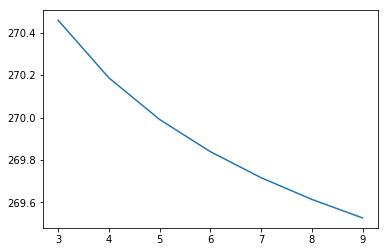
[8]:
ser_z_U=pd.Series(np.arange(3,10,1))

df_QE_zU=pd.DataFrame({x:calc_PM(Qn, QG, e, Ta, U, z_U=x) for _,x in ser_z_U.iteritems()})

df_QE_zU.max().plot()
[8]:
<matplotlib.axes._subplots.AxesSubplot at 0x117dd9cf8>
Impacts of measurement height of surface roughness length z0
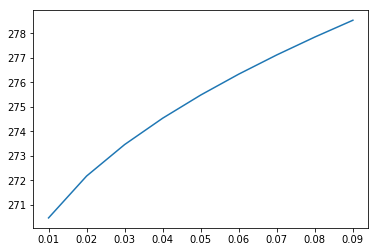
[9]:
ser_z0=pd.Series(np.arange(0.01,0.1,0.01))

df_QE_z0=pd.DataFrame({x:calc_PM(Qn, QG, e, Ta, U, z0=x) for _,x in ser_z0.iteritems()})

# df_QE_z0.mean().plot.barh()

df_QE_z0.max().plot()
[9]:
<matplotlib.axes._subplots.AxesSubplot at 0x117eb4240>
Example 2: Wind and Temperature Profile
Basics about wind and temperature profiles
neutral conditions
The variation of mean wind speed \(\bar{u}\) with height \(z\) (in surface layer, above the RSL) above an aerodynamically rough surface can be represented by a logarithmic relation:The variation of mean wind speed \(\bar{u}\) with height \(z\) (in surface layer, above the RSL) above an aerodynamically rough surface can be represented by a logarithmic relation:
where where \(u_*\) is the friction velocity (\(u_*^2=-\overline{u'w'}\)) (rate of vertical transfer by turbulence of horizontal momentum per unit mass of air), \(z_0\) is the roughness length of the surface for momentum, \(d\) is the zero-plane displacement and \(k\) is von Karman’s constant (0.4).
The logarithmic law is strictly valid only in neutral conditions, i.e. when the effect of buoyancy on turbulence is small compared to the effect of wind shear. In such conditions, the temperature profile in the surface layer will be close to adiabatic (i.e. \(dT/dz = –9.8 \textrm{ K km}^{-1}\) or potential temperature is constant with height). When the sensible heat flux is significantly different from zero, Monin-Obukhov theory must be used.
non-neutral conditions
Modifications to the logarithmic profile are required in conditions of non-neutral stability, using the results of Monin-Obukhov theory. This theory of the surface layer derives relations between the vertical variation of wind speed \(u(z)\) and potential temperature \(\theta(z)\) (which approximates the measured temperature \(T\) close to the surface), the scaling factors for momentum and temperature, \(u_*\) and \(T_*\), and the Monin-Obukhov stability parameter,
where \(L\) is the Obukhov length and \(z' = z - d\).
NB: the surface temperature \(\theta_0\) is an absolute temperature (units: K).
The logarithmic profile relation can be rewritten for wind speed to include the stability corrections:
and similarly for potential temperature:
where the turbulent temperature scale is given by
\(\Psi_m\) is the stability correction function for momentum and \(\Psi_h\) is the stability correction function for heat. Note that both \(T_*\) and \(z’/L\) have the opposite sign to \(Q_H\) (which is positive in unstable conditions and negative in stable conditions).
stability correction functions
The above mentioned stability corretion functions are formulated based on the Monin-Obukhov similarity theory (MOST) and their actual forms must be determined theoretically (e.g., Katul et al. (2011), Li et al. (2012)) or empirically (e.g., Högström (1988)).
One example by Kondo (1975) is as follows:
- unstable conditions:
- stable conditions:
Unstable case
import raw data
[10]:
# data_raw=pd.read_csv('WP_PM_rawdata.csv',header=0,skiprows=[1]).dropna(how='all')
data_raw = pd.read_csv('../data/WP_unstable_rawdata.csv', header=[0, 1]).dropna(how='all')
data_raw
[10]:
| z | U_obs | T_obs | |
|---|---|---|---|
| (m) | (m/s) | (C) | |
| 0 | 0.56 | 1.84 | 24.91 |
| 1 | 0.80 | 1.97 | NaN |
| 2 | 1.12 | 2.16 | 24.39 |
| 3 | 1.60 | 2.38 | NaN |
| 4 | 2.24 | 2.63 | 23.76 |
| 5 | 3.20 | 2.89 | NaN |
| 6 | 4.48 | 3.09 | 23.90 |
| 7 | 6.40 | 3.47 | NaN |
implement the stability correction function
[11]:
# Psi for momentum under unstable condition
def Psi_m_unstable(z_d, L):
    z_L = z_d/L
    Psi_m = 0.6*(2)*np.log((1+(1-16*z_L)**0.5)/2)
    return Psi_m


# wind profile function
def func_u_z(z, u_star, z0, d=0.01, L=-2.1998, k=0.4):
    crt = np.log((z-d)/z0)-Psi_m_unstable(z-d, L)+Psi_m_unstable(z0, L)
    fit_u_z = u_star/k * crt
    return fit_u_z


# form for fitting
def func_fit_u_z(z, u_star, z0):
    return func_u_z(z, u_star, z0)
fit curve by scipy.optimize
[12]:
from scipy import optimize
params, params_covariance = optimize.curve_fit(func_fit_u_z,
                                               data_raw.z.values.flatten(),
                                               data_raw.U_obs.values.flatten())
pd.Series(params,index=['u_star','z0']).to_frame().T
[12]:
| u_star | z0 | |
|---|---|---|
| 0 | 0.468304 | 0.083681 |
examine the fitted curve
[13]:
# clean the labels
data_fit = data_raw.copy()[['z', 'U_obs']]
data_fit.columns = data_fit.columns.droplevel(1)

# data_fit
data_fit['U_fit'] = func_fit_u_z(data_fit.z, *params)
data_fit
[13]:
| z | U_obs | U_fit | |
|---|---|---|---|
| 0 | 0.56 | 1.84 | 1.705202 |
| 1 | 0.80 | 1.97 | 1.980512 |
| 2 | 1.12 | 2.16 | 2.225307 |
| 3 | 1.60 | 2.38 | 2.470980 |
| 4 | 2.24 | 2.63 | 2.691432 |
| 5 | 3.20 | 2.89 | 2.914837 |
| 6 | 4.48 | 3.09 | 3.117291 |
| 7 | 6.40 | 3.47 | 3.324439 |
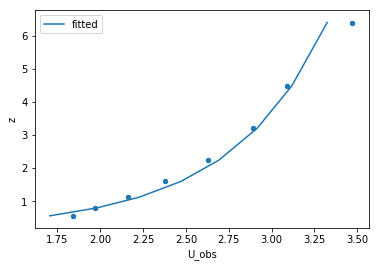
[14]:
ax = data_fit.plot.line(x='U_fit', y='z', label='fitted')
data_fit.plot.scatter(ax=ax, x='U_obs', y='z')
[14]:
<matplotlib.axes._subplots.AxesSubplot at 0x115bb3320>
exercise: fit the temperature profile
[15]:
# what stability corrections should be used for temperature profiles?

# what is the fitting function for temperature profiles?
Stable case
exercise:
[16]:
# adapt the above analysis under unstable condition to the stable condition
- wind speed profile
[17]:
# adapt the above analysis under unstable condition to the stable condition
- temperature profile
[18]:
# adapt the above analysis under unstable condition to the stable condition
Exploration: impacts of surface roughness on the profiles
Think about:
- How is surface roughness accounted for in the calculation of the above profiles?
- Do wind directions matter in the above calculations?
[19]:
# write your code here to answer the above questions